
The importance of updating affidavits in family provision claims has recently been highlighted in the decision of Baker v Baker [2024] NSWSC 559 (Hammerschlag CJ in Eq).
Before the Court can make a family provision order, it must be satisfied that any provision made for the applicant is inadequate “at the time when the Court is considering the application” (s 59(1)(c). Only on being satisfied of the inadequacy of provision, then may the Court exercise its discretion to make an order “for the maintenance, education or advancement in life of the eligible person, having regard to the facts known to the Court at the time the order is made.” (s 59(2)). The statutory language expressly turns the Court’s attention to the personal and financial circumstances of the Plaintiff at the time the application is being considered.
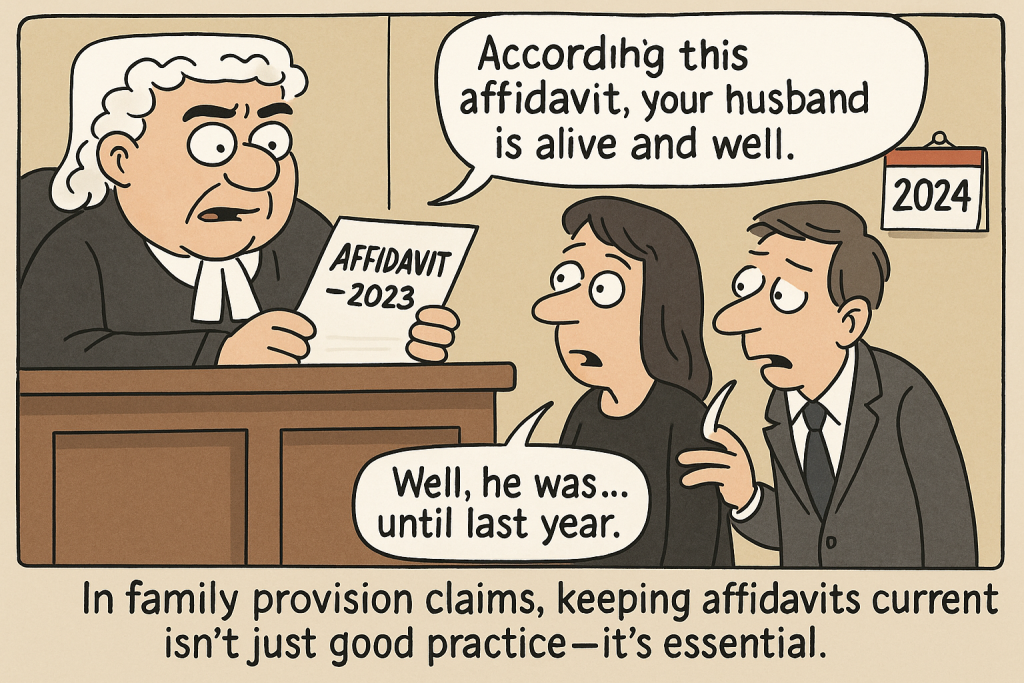
Bringing to the Court’s attention the up to date personal and financial circumstances of applicants and competing beneficiaries is achieved by so-called “updating affidavits”. Current Practice Note SC Eq 7 at paragraph 32 provides that, if a matter does not settle, the Court may make directions to prepare the matter for final hearing including for an “updating affidavit by any party or beneficiary.”
In Baker v Baker no order for updating affidavits was made: [23] Ordinarily, parties would seek those orders be made at the time of the allocation of the hearing date, or at the latest at any pre-trial direction.
In Baker v Baker there was a change in circumstances for one of the plaintiff’s which was revealed as follows:
“During cross-examination, however, she [the relevant applicant] revealed (to the obvious surprise of counsel appearing for her – who told me from the bar table that this was the first time he and his instructing solicitor had been told this) that her husband had since passed away and that she was now living with one of her daughters and is on the Newstart allowance. Living with her are her daughter, her granddaughter, and two great-grandchildren.” ([44])
At [45] – [46] his honour briefly stated:
“Her own financial circumstances, the financial circumstances of her daughter, the arrangements, if any, under which she lives with her, and her now financial needs and requirements were not revealed.
It became clear that pertinent facts had not been placed before the Court. I cannot make the evaluative judgment which s 59(1)(c) requires the Court to make.”
On being satisfied that this particular applicant had not persuaded the Court of the inadequacy of provision ([49]-[50]) and the non-disclosure of the change in circumstances, the claim was dismissed: [59]
The result should not be surprising in light of his honour’s other family provision decision Stone v Stone [2019] NSWSC 233.